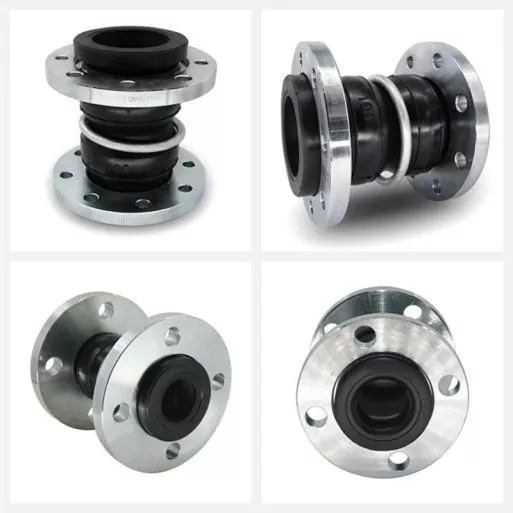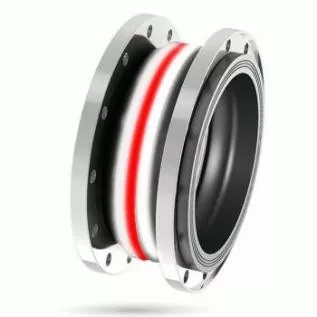
JIDONGDA supplies the Double Sphere Rubber Expansion Joint for industrial pipeline systems that require reliable vibration isolation, movement compensation, and connection flexibility. Designed with a double-sphere rubber body, reinforced fabric layers, and stainless steel mesh protection, this flexible component is suitable for demanding piping applications involving pumps, compressors, water systems, air, oil, mild chemicals, and other industrial fluids.
A double-sphere expansion joint is designed to absorb pipeline movement while helping reduce vibration and stress transferred from connected equipment into the piping system. Compared with a single-sphere structure, its two-sphere geometry provides additional flexibility and movement absorption. JIDONGDA offers reinforced rubber expansion joints using materials such as EPDM, NBR, and Neoprene, with multi-layer fabric reinforcement and an external stainless steel mesh layer. Depending on the design, available specifications can cover DN32–DN600, PN10/PN16/PN25 pressure classes, and temperature ranges from -20°C to +120°C, with special compounds available for higher temperatures.
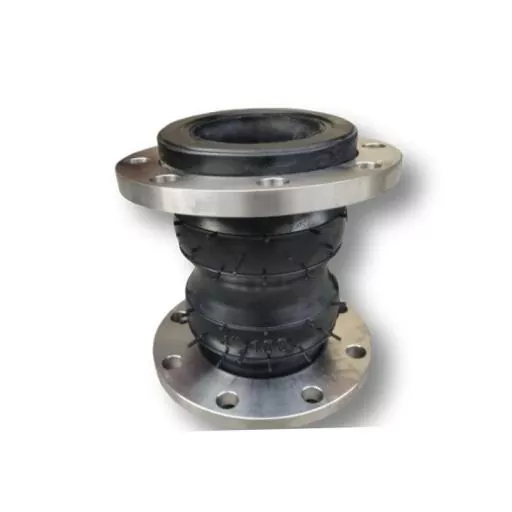
Table of Contents
- What Is a Double Sphere Rubber Expansion Joint?
- Why Is It Important in Industrial Piping Systems?
- How Is the Joint Constructed?
- What Are the Main Performance Advantages?
- What Technical Specifications Should Buyers Check?
- Where Can It Be Used?
- How Should Buyers Select the Right Model?
- What Should Be Considered During Installation?
- Frequently Asked Questions
- How Can You Request a Customized Solution?
What Is a Double Sphere Rubber Expansion Joint?
A double sphere rubber expansion joint is a flexible pipeline connection component consisting of two spherical rubber sections. Its primary purpose is to accommodate movement and reduce the transmission of vibration between equipment and connected piping.
Unlike rigid pipe connections, the flexible rubber structure can respond to axial, lateral, and angular movement. This makes the joint particularly useful around rotating or reciprocating equipment where vibration and pressure fluctuations can place additional stress on pipelines.
The double-sphere configuration is especially useful when a piping system requires greater flexibility and vibration absorption than a conventional single-sphere connector can provide. The spherical geometry distributes movement through the flexible rubber body rather than concentrating all movement at a rigid connection point.
For buyers comparing rubber expansion joints, the double-sphere design should be evaluated according to operating pressure, temperature, media, movement requirements, flange configuration, and installation conditions.
Why Is It Important in Industrial Piping Systems?
Industrial pipelines are rarely exposed to completely static conditions. Pumps start and stop, compressors generate mechanical vibration, fluids create pressure fluctuations, and temperature changes cause connected components to expand or contract.
Without adequate flexibility, these dynamic forces may be transferred directly into pipes, flanges, valves, pumps, and other equipment. Over time, repeated loading can contribute to fatigue, connection stress, leakage, or premature component wear.
A flexible expansion joint helps isolate these effects. Its rubber body provides a controlled movement zone between rigid piping sections, while reinforcement layers support the structure under operating loads.
- Absorbs equipment-generated vibration.
- Compensates for pipeline movement.
- Helps reduce stress concentration around connections.
- Accommodates thermal movement and installation tolerances.
- Supports more stable operation of dynamic piping systems.
- Helps protect connected equipment from excessive vibration transmission.
How Is the Joint Constructed?
The performance of a flexible expansion joint depends heavily on its geometry, rubber compound, reinforcement structure, and connection design. A typical reinforced double-sphere configuration combines several functional layers.
Double-Sphere Rubber Body
The two-sphere geometry creates a flexible working section capable of handling movement in multiple directions. The curved structure also allows deformation without relying on a completely rigid connection.
Multi-Layer Fabric Reinforcement
Fabric reinforcement is incorporated into the rubber body to improve pressure resistance and fatigue durability. The reinforcement structure is selected according to the required pressure class and application conditions.
Stainless Steel Mesh Protection
An external stainless steel mesh layer can provide additional mechanical protection and structural support. It is particularly valuable in environments where the expansion joint is exposed to dynamic loads and repeated vibration.
Flanged Connection
Flanged ends provide a practical method of connecting the flexible joint to existing piping. Correct flange dimensions, bolt patterns, gasket selection, and alignment are important for maintaining sealing performance.
What Are the Main Performance Advantages?
The value of a double-sphere rubber expansion joint extends beyond simple pipeline flexibility. Its construction addresses several common challenges encountered in industrial piping systems.
| Performance Feature | Engineering Benefit | Typical Requirement |
|---|---|---|
| Double-sphere geometry | Provides increased flexibility and movement absorption | Dynamic piping systems |
| Fabric reinforcement | Improves pressure resistance and fatigue durability | Pressurized pipelines |
| Stainless steel mesh | Provides additional mechanical protection | High-vibration environments |
| Rubber flexibility | Reduces vibration transmission | Pumps and compressors |
| Flanged connection | Supports stable installation and sealing | Industrial pipe networks |
| Custom rubber compounds | Allows adaptation to different media and temperatures | Specialized applications |
These characteristics make the product suitable for applications where a conventional rigid connector may not provide enough flexibility or vibration isolation.
What Technical Specifications Should Buyers Check?
Choosing a flexible joint should start with actual operating conditions rather than simply selecting a nominal pipe diameter. The following specifications are particularly important when evaluating a double-sphere design.
| Specification | Available / Typical Range |
|---|---|
| Structure | Double sphere rubber body + fabric reinforcement + stainless steel mesh |
| Rubber Materials | EPDM, NBR, Neoprene, customized compounds |
| Reinforcement | Multi-layer fabric and stainless steel wire mesh |
| Working Pressure | PN10 / PN16 / PN25, depending on structure |
| Temperature Range | -20°C to +120°C; special compounds up to +150°C |
| Movement | Axial, lateral, and angular compensation |
| Nominal Size | DN32–DN600; larger sizes available by customization |
| Connection | Flanged or custom-engineered fittings |
| Compatible Media | Water, air, oil, mild chemicals, and industrial fluids |
Actual selection should always be based on the complete system design. Pressure, temperature, fluid composition, movement amplitude, flange dimensions, and installation environment should be confirmed before production.
Where Can It Be Used?
A double-sphere flexible connection is particularly relevant to piping systems where vibration, movement, or mechanical stress cannot be completely eliminated.
Pump and Compressor Systems
Pumps and compressors are common sources of mechanical vibration. Installing a flexible joint near the equipment can help limit the transfer of vibration into the connected pipeline.
Water and Fluid Piping
Water treatment, industrial water circulation, and general fluid transportation systems can use rubber expansion joints to accommodate movement while maintaining flexible connections.
Industrial Process Lines
Systems transporting compatible oils, air, mild chemicals, and other industrial fluids can use different rubber compounds according to the required media resistance.
Complex Pipeline Layouts
Where multiple pipe sections, equipment connections, and structural tolerances create alignment challenges, a properly selected flexible joint can provide additional movement capacity.
How Should Buyers Select the Right Model?
Procurement teams should provide detailed operating information when requesting a quotation. This enables the manufacturer to match the rubber compound, reinforcement, size, pressure rating, and connection configuration to the actual application.
- Confirm pipe diameter: Identify the required DN or nominal pipe size.
- Check operating pressure: Select a pressure class suitable for normal and transient operating conditions.
- Identify operating temperature: Consider both normal temperature and potential peak temperature.
- Specify the medium: Water, oil, air, chemicals, and other fluids may require different rubber compounds.
- Measure movement: Determine expected axial, lateral, and angular movement.
- Confirm flange dimensions: Bolt-hole patterns and connection dimensions must match the pipeline.
- Consider installation environment: Outdoor exposure, vibration intensity, and surrounding equipment can affect the final configuration.
Providing these details early can reduce specification errors and make OEM customization more efficient.
What Should Be Considered During Installation?
Even a properly engineered expansion joint requires correct installation. The flexible body should not be treated as a substitute for proper pipe support or alignment.
- Check flange alignment before tightening bolts.
- Use compatible gaskets and correctly specified fasteners.
- Avoid excessive stretching, compression, or twisting during installation.
- Ensure adjacent piping is properly supported.
- Prevent sharp objects or external components from damaging the rubber body.
- Verify that operating movement remains within the designed compensation range.
- Inspect the joint periodically for visible wear, cracking, deformation, or connection problems.
Proper installation helps the joint perform according to its intended design and can reduce unnecessary mechanical loading on the flexible element.
Frequently Asked Questions
1. What is the main advantage of a Double Sphere Rubber Expansion Joint?
The main functional advantage is its ability to provide increased movement absorption and vibration isolation through a double-sphere flexible structure.
2. What materials are available for the rubber body?
Common material options include EPDM, NBR, and Neoprene. Customized rubber compounds can also be considered when the operating medium or temperature requires a specific formulation.
3. What pressure ratings are available?
Depending on the structure and application requirements, configurations can be designed for PN10, PN16, or PN25 working pressure classes.
4. What sizes can be customized?
The referenced product range covers DN32 to DN600, while larger sizes can be considered according to project requirements and engineering specifications.
5. Can it be used near pumps and compressors?
Yes. Pumps and compressors are typical installation locations because these machines can generate vibration and dynamic loads that need to be isolated from connected pipelines.
6. Can the connection type be customized?
Yes. Flanged connections are available, and custom-engineered fittings can be developed according to the pipeline configuration and project requirements.
How Can You Request a Customized Solution?
For industrial buyers, selecting the correct flexible joint is a combination of product specifications and system engineering. JIDONGDA provides customized rubber expansion joint solutions covering different diameters, rubber compounds, reinforcement structures, pressure requirements, and connection configurations. When requesting a quotation, provide the pipe size, operating pressure, temperature, media, movement requirements, flange dimensions, and application environment whenever possible. These details allow the manufacturer to evaluate the appropriate configuration more accurately.
If you are sourcing a reliable flexible connection for a pump, compressor, water pipeline, industrial process system, or other demanding application, contact us to discuss your operating conditions, customization requirements, technical specifications, and bulk-order needs with JIDONGDA.